

With over 142,000 property settlements in NSW (and over 722,000 nationwide) during the 2024/25 financial year, real estate continues to be an intensely competitive industry as agents vie for sales and the associated commissions.
Given the sheer volume of sales activity, in conjunction with the rising number of commission disputes between agents, it has never been more pertinent for vendors to be vigilant when entering a commercial arrangement with a real estate agent for the sale of a property.
It is essential for vendors to have a comprehensive understanding of the contract terms outlined in an exclusive agency agreement, particularly Clause 9 in a Real Estate Institute standard contract, which focuses on an Agent’s Commission and Reimbursement.
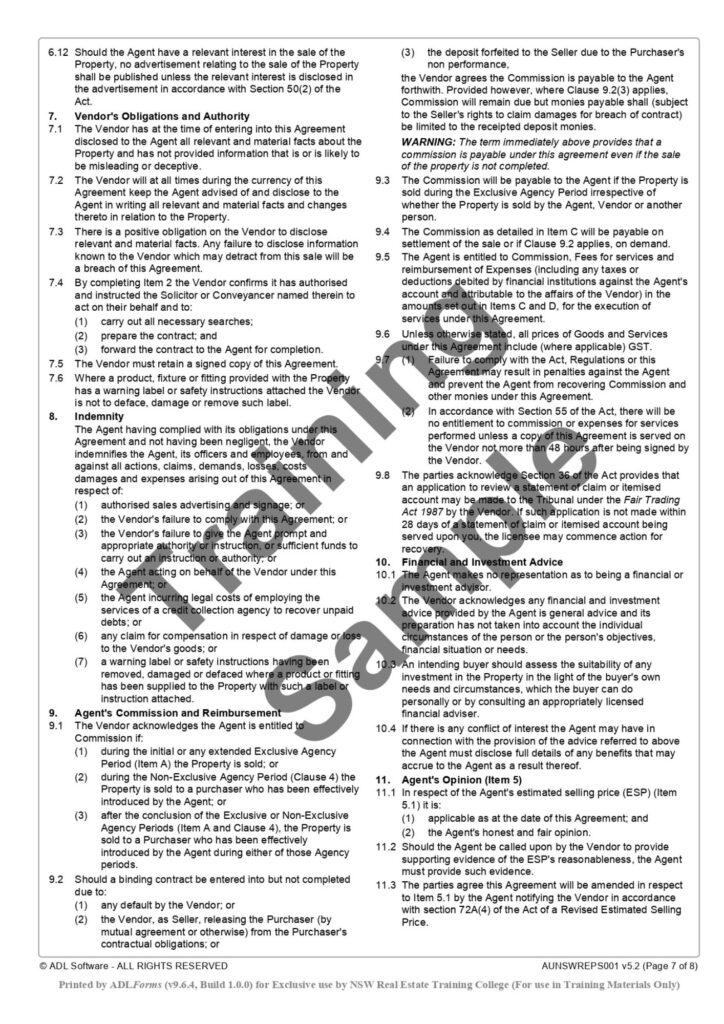
This contract clause could potentially result in a vendor being liable for the payment of two commissions should they engage more than one agent when selling a property. This can happen if the first agent appointed to sell a property is unsuccessful, and the owner terminates the first agency agreement, and appoints a different agent who is successful. Given the significant and unnecessary financial stress this can cause vendors, it is important to protect oneself and minimise this risk when selling property.
When is a vendor liable for two commission payments?
It is standard practice for a real estate agent to receive sales commission upon the completion of a property sale.
However, what is the consequence if a buyer, whom the initial real estate agent introduced to a property, returns at a later date to buy the property through another real estate agent?
In this situation there is always the possibility for a dispute to arise between the vendor and the initial real estate agent as to whether the initial agent is entitled to a sales commission, even though the property sale was not completed successfully through the initial agent. In many cases agents resolve these issues between them, but not always.
This can result in the owner being obliged to pay full commission to both agents. Whether that is the outcome will depend on a range of factors, but a critical question is whether an agent was the effective cause of the sale.
What is effective cause?
The standard Real Estate Institute’s (REI’s) agency agreement refers to commission being payable based on ‘effective introduction’ (as per the image above) – but what does that term mean? The courts have looked at this, and have generally found that an agent must be the ‘effective cause’ of the sale’ – in that context, “effective introduction” and “effective cause” are essentially interchangeable terms.
Several important court decisions indicate how the effective cause of sale can be determined, and also exemplify how different factors in each case must be taken into consideration when establishing whether an agent has a valid claim in their commission dispute.
The customary test for “effective cause” is stated by the High Court of Australia in the 1977 case
L J Hooker Ltd v W J Adams Estates Pty Ltd
“Effective cause” means more than simply “cause”. The inquiry is whether the actions of the agent really brought about the relation of buyer and seller and it is seldom conclusive that there were other events which could each be described as a cause of the ensuing sale. The factual inquiry is whether a sale is really brought about by the act of the agent”.
Much more recently, in the 2023 case Freedom Development Group Pty Limited v D’Ettorre Properties Pty Limited T/as D’Ettorre Real Estate, the NSW Court of Appeal held that:
to be an “effective introduction” of “the purchaser” … there must be a sufficient causal nexus between the “introduction” of the purchaser and the ultimate sale of the property to the purchaser. What is a sufficient connection is a question of fact in each case.
However, each case still turns on its own facts (as every court case does). The court decisions do not dismiss the possibility that in a particular case both the initial agent and the subsequent agent provided the “causal nexus” – there would be a heavy burden of proof on the initial agent, but it is not impossible.
Furthermore, the particular wording of the agency contract can make a difference. In the 2007 English case Dashwood v Fleurets the High Court held that an agent who had effected an “introduction” was entitled to commission even though another agent closed the sale, because the agency agreement did not specifically require “effective cause”.
We are increasingly seeing agency agreements where the standard wording has been replaced to make the commission (purportedly) payable if the ultimate purchaser is “introduced” by the agent (with no mention of “effectively”). This may be a laudable effort to simplify language, or it may be an attempt by the agent to strengthen its claim to commission in a dispute situation.
How can a vendor protect against commission disputes?
When it comes to resolving commission disputes between two agents over one property, the case law confirms that a high threshold must be met for an agent to be entitled to a commission.
Nevertheless, vendors still risk being found liable for two commission payments should they choose to use two agents if the agency agreement terms are unclear, ill-defined, or adverse to the vendor’s interests.
Given the costly consequence of paying two commissions, it is important for vendors to proactively address this potential issue by taking a few initial steps to prevent a commission dispute from breaking out in the first place:
- Have a clear, written and signed agency agreement, which is ideally an exclusive agency agreement that limits the agent numbers to one to avoid multiple agents claiming commission. Insist that the commission clause is expressed in the standard “effectively introduced” terms. If the agent doesn’t like it, get another agent.
- Include a special condition in the Contract for Sale which requires the purchaser to confirm they have not been introduced to the property via another real estate agent and that indemnifies the vendor in the event of a claim for commission.
- Astutely manage any transition between real estate agents to ensure that only the agent who is the “effective cause” of the property sale is paid.
- Request that any initial real estate agent provides you with a list of prospective buyers they introduced to the property at the end of the agreement period to minimise the risk of overlapping claims.
- Terminate any previous agency agreements using a formal written release from the initial real estate agent.
As long as we sell properties through agents the possibility of disputes cannot be eliminated entirely. However, these few simple steps will make those disputes much less likely, and will help make the process of selling a property a more streamlined and less stressful experience.
If you have any questions or would like some guidance when it comes to property transactions, feel free to reach out to our team at Antcliffe:Scott. Our team is more than happy to help you.